Monday, February 27, 2012

The Internet Echo Chamber


Since the beginning of the year, a Catholic blog has been bashing Clark and The Scarlet for various reasons,
all relating to the general opinion of the author concerning homosexual agendas, a growing secular-minded nature of higher institutions, and the belief that christianophobia is rampant therein.
The blog, La Salette Journey has singled out figures such as Dean of students Denise Darrigrand, Professor Abbie Goldberg, and Professor Debórah Dwork for various reasons. The author, Paul Melanson, has also called attention to a "Christianophobic" atmosphere on campus and recently has questioned the causal relation between last week's sexual assault and the Vagina Monologues, which were preformed in the same time period (see article here).

Before the more recent articles, The Scarlet published an opinions article in response to Melanson's pieces questioning the atmosphere here as welcoming and nondiscriminatory (see article here).


This seemed ridiculous to every student I spoke to. How could someone think this? It appears that the author has no tie to Clark and has never visited the campus. The article went online, and La Salette Journey latched on. Since, the blog has rehashed the same opinions in response to our article and has recently discussed one writer's review of The Vagina Monologues.

Melanson at La Salette Journey writes: "Jeremy's review of The Vagina Monologues is so disturbing that it reads like the transcript of a serial rapist who is fixated on women's vaginas..." I can assure you Jeremy is the antithesis of this. He's awesome.

Between these two periods of time, comments on our article piled up. According to comments there and across the Web, Paul Melanson is creating an echo chamber and using fake accounts to mirror is own opinions; the comments on his blog are his.

Having not checked the IP addresses myself, I can't verify this, but having studied this particular situation, it's totally believable.

This brings me to the topic of this post: how the internet can become an echo chamber.
As seen in this case, it's completely feasible 1) that someone can post slanderous harassment online at their will 2) that one can anonymously hide and change character behind a screen and 3) that those with strong views and opinions never have to leave their comfort zone.
The internet is a very mixed place, and with a little Googling, you can find people who agree or disagree wholeheartedly with what you're saying. But when users are only interested in
staying in one position or anonymously "trolling," things get messy.

Trolling is internet slang for an individual who is trying to get a rise out of someone and cause a desired reaction. Melanson may have different reasons for latching onto Clark (and other groups and institutions in the past), but it appears that he is only using the negative and aggressive
tactic of trolling to further his views and garner visits to his blog.

Blogs are a prime example of how much people love to hear themselves talk, and likewise, hear those who agree with them.

He'll probably find this, too. Who knows, my name may be in the next blog post. But as the old adage goes, "There is no such thing as bad publicity." Thanks, La Salette Journey for giving us such entertaining stuff to read... but try to be kind about it. I'm sure Darrigrand would appreciate it.


Monday, February 20, 2012

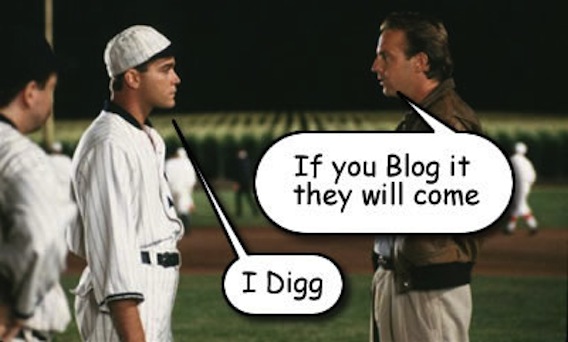
If you build it, they will post


This week's readings made me really think about how interesting online involvement can be. There is no physical presence, no visible organization, but behind the screens and keyboards is a world of people all desiring to share and link information about things and to one another. The groundswell is a powerful force that just needs a structure to fill. If you build it, they will post.

In our book's example of Mass General Hospital's communication system in place, we see a need in the community. Those who are at the hospital were in need of this manner of communication. Someone realized this, a structure was implemented, and the groundswell took over. CarePages obviously filled a need in that community.

This taps into the power of Web 2.0. Everyone wants to share and disseminate information about themselves, things they like, or anything else. In specialized cased like that of MGH, patients and families needed a space to communicate and share information.

Groundswell explains that when you enable a group to use something they need, they will. The social nature of the web and CarePages shows the innate desire to connect; patients needed a different venue.

The same can be said other internet phenomenons. When chat rooms were being used by internet users, they used them to fill whatever needs they had - be it a desire to meet strangers or get IT help. Forums have also served this purpose, as well as filled the desire for individuals to group together and discuss a central topic. Fans of bands, television shows, activities, or sports teams can now access an online community for information or discussion.

As the book tells us, this online tool and community atmosphere is not only beneficial to the users; it is also gives the company or organization behind the tool a better understanding of what their target audience desires. This will also give you better insight into expanding and planning your company and product, or using the groundswell. It is a mutually beneficial situation. As we've discussed in class, it is all about working for the customer while making the customers work for you. Customers want to feel empowered, have choice, and feel like they are getting the most out of their experience. If your company is interacting with them in a useful manner, customers will feel validated and important and want to stay with what they are using. They will feel like they are a part of the organization. The groundswell is a powerful force, but it's not a one-way street. But to get to this point, you must know what the groundswell needs.


I thought LinkedIn's use of mapping was very interesting and shows how the growth of a social network can really take off, if the desire is there.

Monday, February 13, 2012

The dreaded technology loop


Things are often different in theory and in practice. In theory, being plugged into the World Wide Web and its myriad way of communicating seems like a good idea. Smart phone? Definitely. An iPad? Sure, throw that in your suitcase too.

Checking your blog, email, other email, Twitter, Facebook, and other social media outlets becomes habitual. Having multiple tabs in a web browser seems necessary now that the Internet has been around for a while, and occasionally, I'll have multiple pages with other tabs. Word processing docs pile up, and before I know it, I haven't seen my desktop in days.

Flights used to be a bore, but once I've gotten my iPod, my laptop, a movie and/or book in my hands, filling those hours is no problem.

But all of these different branches of communication and social media have come with a price, and I think IFC's latest hit, Portlandia, has hit the nail on the head:


I'm definitely in a technology loop. It's part of the reason I've resisted getting a smart phone. I don't think I could handle one more gadget or being connected all the time. As it is, I already feel like I'm sucked into the digital world more often than not.

Like Fred Armisten's character in the video, I feel that it's all too easy to get wrapped up in the maddening digital world. Everything is available all the time instantaneously; we're the ones who can't keep up usually, not computers.

All this information doesn’t seem excessive until I notice just how much is on my plate. And I wonder why I have trouble concentrating in the age of information…

Carrie Brownstein's answer - MindFi - is hilarious... until you start to think of it as a real possibility. And of course, the advertising joke is also funny, but frighteningly close to home. It's already everywhere. How much longer until we're even more plugged in?

Saturday, February 4, 2012

The "POST" Strategy


"It's not technology for its own sake."
...words from our Social Media and Marketing Communication professor, Julie Frechette. As we discussed practices in forming a sound business and likable practices, this became evident; it doesn't matter what flashy tools you're using to garner web traffic if your foundation is not highlighting the principles that consumers value. Practices of transparency and porosity keep these in check.
In Groundswell, the authors cover "Strategies for Tapping the Groundswell" in chapter four. In this chapter, they explain the POST method - People, Objectives, Strategies, and Technology, and how your model can fail if you cater to technology first.
An anecdote opens the chapter. A client, whose business is competing with Sears has noticed their online community and asks for advice on starting on of his own. "What's your objective?" they ask him. He replies that since Sears has done this model, that they should follow suit. This, the authors claim, is definitely the wrong reason. Indeed, it's not the technology you have, but your market, that matters. Companies know they need to get involved in this digital world, but aren't sure how, and are missing the big issue.
The book's POST method underscores the problems with this mentality.
"The problem with... so many of our clients is that they're going about their strategy backward. They start by thinking about technology. But technology is shifting so quickly--chasing it is like trying to jump on a speeding merry-go-round."
The authors note that asking what your customers are ready for is your first step, which makes perfect sense; the whole game is knowing your audience. In the anecdote above, the client was more concerned with his competition than his own audience. Knowing how to cater your goods and services to your audience is paramount in achieving success and feedback.
The next step is realizing your objective. As with any task, meaningfulness is the foundation. Without knowing your goals, it's impossible to get what you want. This step, and the next - Strategy - will help you to achieve a desired effect. Know what you want from your target audience and what you want from your efforts.
Last, but not least, is where Technology comes in. Only after answering the previous questions about your endeavors will you be able to best use the technology at your disposal. The more clarity and information you gather beforehand, the better your chances of using the groundswell.
To go back to our professor's words in class, using technology for the sole purpose of using it is blind; you need to know who your audience is and what you want to do with it before using it.

Wednesday, February 1, 2012

Digging up the Underground: Social Media and Counterculture


If there’s one thing social media has succeeded in doing, it’s diminishing the spaces between us and the space between us and knowledge. The digital age and our newfound digital interactions have become a springboard into a new, hyper-awareness. While it’s arguably a good thing to be a more informed citizen (as one of the tenants of a healthy democracy), there are other implications. How is it changing how we interact? How is it affecting our culture? And how is it morphing what used to be a hidden sector of society?

One of my flat mates and I were sitting around our kitchen the other night, cooking and doing what usually happens to the idle-minded: Facebooking. Yes, I’m going to condone the use of that word as a verb for the time being. After a while, she noticed that a bunch of her friends were attending an event – a small show at a little known venue back home. This prompted the question: how did people find out about things before the internet? Communication is nowhere near what it once was.

Before we all became so attached to this cyber snare of communication and information that we now know as the World Wide Web, events like concerts and small shows were only heard about through traditional word of mouth. Sure, flyers help, too, but for the most part, if you didn’t hear about it, you didn’t know about it. The underground music scene really was very secretive.

With the addition of Facebook’s Events application and further with the addition of things like foursquare and “check-ins” everyone knows where everyone is all the time. It’s weird. This translates to there being far less privacy (and let’s not forget to mention that we’re all willingly giving up our privacy when using the social networking site). Underground shows are now inviting people to attend via Facebook. Raves and places like the Firehouse in Worcester are now “likable.” Everyone is now so much more aware.

Underground music is all much easier to access now. With FTPs and torrent sites hosting little known artists, anyone can become immediately acquainted with small bands from around the world. Variables of time and place aren’t factors anymore; you can be anywhere and hear music that was made years ago and miles away.

With the internet has come a very jarring change to counterculture and the underground. Simply put, I don’t think there is an underground anymore.